Research highlight
Lasers in the sky for high-speed internet
Vincent van Vliet from the High Capacity Optical Transmission Laboratory is one of the ten recipients of the 2025 IEEE Photonics Society Graduate Student Scholarships. Having published 29 papers to date, 6 of which as a first author, the PhD researcher has been extremely productive in his research into free-space optical communication.

‘It is a great honor to receive this recognition, and I am looking forward to collecting my prize during the IPC in Singapore,’ Vincent van Vliet smiles. The prizes are based both on the candidates’ research and on their contributions to the optical community at large, he explains. ‘As a President of the Photonics Society Eindhoven I have actively contributed to the community, for example by welcoming over 90 students from all over Europe last May for a three-day event. In addition, I organize special sessions during scientific conferences called “Hack Your Research!,” where researchers demonstrate how they have automated certain tasks and share their software for others to use.’
In his own research, Van Vliet is exploring the field of long-range infrared wireless optical communication, which is new at TU/e. ‘We have a lot of knowledge about using infrared light for high-capacity data transmission in fibers. Now we wanted to explore if, and if so how, we could use that expertise to also send information from transmitter to receiver through the air.’

"We acknowledge that the transition towards quantum secure networks has to be a gradual one"
Idelfonso Tafur Monroy | Founding father of this testbed
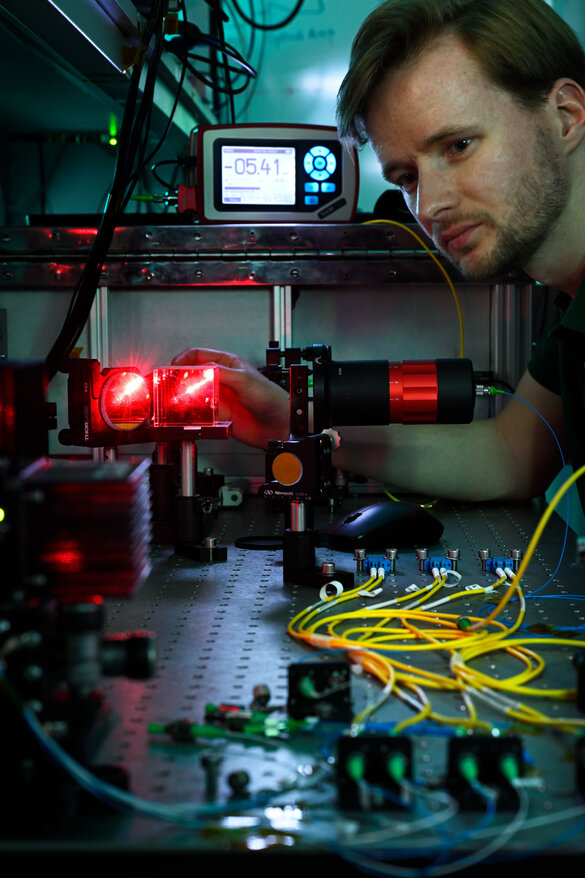
The vision is not that optical free space communication will replace other systems, but that it can be added to the existing networks to improve their overall performance
Vincent van Vliet | PhD Candidate
Ultimate combination
The aim is to combine fast fiber optics with the flexibility of wireless solutions, the enthusiastic PhD researcher explains. ‘This can be favorable in areas or under circumstances where you need broadband but cannot install fiber optics: for example, crossing a river, or in the case of disaster and recovery. Currently, in those cases communication often takes place via radio channels, but with infrared light you can send data many orders of magnitude faster. A second advantage of using light over radio is that light allows you to communicate in an extremely targeted way, which makes it difficult to eavesdrop.’
In the envisioned system a stream of data is coupled out of a glass fiber into free space, where it is transmitted through the air from an antenna on one side to a receiver somewhere else. At the receiver end the laser beam is collected from the air and focused on an optical fiber.
Record-breaking datalink
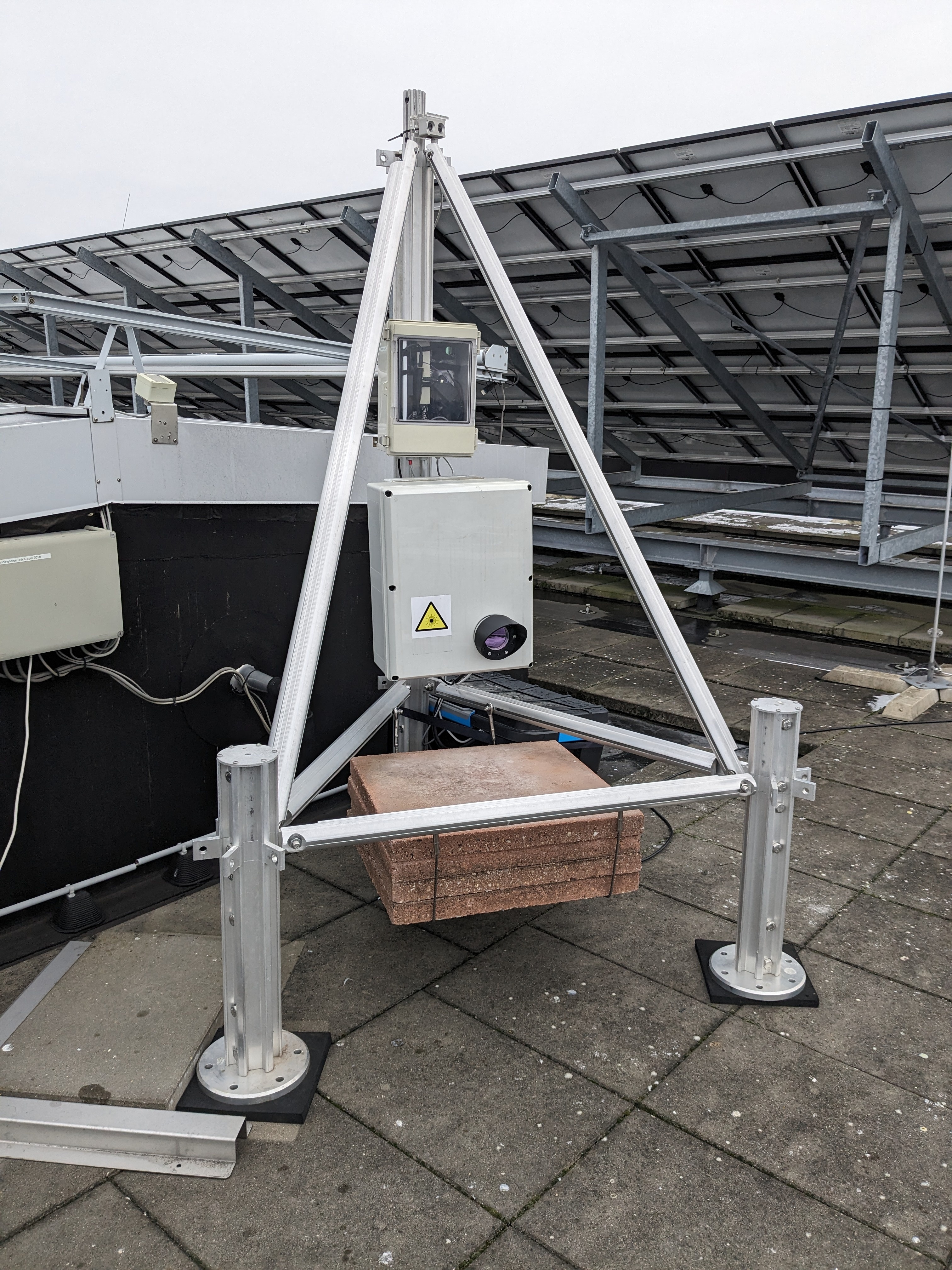
Together with Aircision, a spin-off of TNO that develops products for ultra-high capacity optical wireless systems, the TU/e researchers built such an infrared free-space datalink testbed, spanning 4.6 kilometers between the TU/e campus in the north of Eindhoven and the High Tech Campus in the south. In April 2025, they reported a record-breaking connection that was able to send 5.7 terabits per second. Van Vliet adds: ‘We have since even achieved 7.7 terabits per second. But those speeds can only be achieved when conditions are favorable.’
In his PhD project, Van Vliet studies the effects of the atmosphere on the light field and how it impacts the reliability and bandwidth of the communication link. ‘First, there is the absorption of the infrared light by the air, which is worst when there are lots of tiny particles in the air. In the Netherlands, if it is foggy or drizzly, you have too much loss in the channel to be able to transmit information, where in other areas of the world phenomena like sandstorms might cause loss of signal.’
In addition, the link suffers greatly from optical turbulence, especially since the data is transmitted only tens of meters above an urban area. ‘This turbulence is caused by solar radiation and warming, and at night it is exacerbated by wind. As a result you can completely miss the fiber with your light beam, or you get speckle effects, which reduce the power that is captured in the fiber.’
In April 2025, they reported a record-breaking connection that was able to send 5.7 terabits per second. ‘We have since even achieved 7.7 terabits per second. But those speeds can only be achieved when conditions are favorable.’
Vincent van Vliet | PhD candidate
Continuous expansion
Though the testbed has already been running for months, it is still being expanded upon, Van Vliet says with pride. ‘We have recently installed dedicated instruments to quantify the average turbulence in the atmosphere between both ends of the link. Together with TU Delft we are now figuring out how to measure these effects at intermediate locations as well.’ A second wish is to also measure weather circumstances more locally, as the researchers are currently using KNMI data that might be too crude for their purposes.
‘Ultimately, we want to create a system that can exchange much more data than radio can, with as few errors as possible,’ Van Vliet sketches the goal of the project. In order to get there, besides quantifying the reliability and capacity of the data link, he is also looking into signal processing techniques to improve the quality of the transmission.
The vision is not that optical free space communication will replace other systems, but that it can be added to the existing networks to improve their overall performance, Van Vliet emphasizes. ‘This system can exchange high-capacity wireless data, but not always. When it is foggy, you need to fall back on alternatives such as radio. During the final months of my PhD, I want to explore for which applications such a system could have most added value.’
Focusing light with invisible patterns

Lasers in the sky for high-speed internet
Gold and glue for seamless 3D integration