9
New entries
Meet Johan Klootwijk, Martin Lee and Sandeep Singh

Johan Klootwijk
Focus on fabrication
It was his love for education that led to the part-time professorship of Johan Klootwijk. Since March 2025, he has been added to TU/e’s groups on Integrated Circuits and Photonic Integration for a combined one day a week.
Read more

Exploring new roads toward the 2D Age
Stacking two flat materials on top of each other and then changing the electronic properties of the resulting material by twisting, sliding, pulling, or compressing them: that is, in a nutshell, what keeps assistant professor Martin Lee busy all day. Since February 2025, the Korean-Canadian researcher has been part of the Advanced Nanomaterials and Devices (AND) group.
Read more
Martin lee
Sandeep Singh
Engineering helpful solutions
After travelling the globe, going from India to Germany, the United States and back, as of July 2025, Sandeep Singh has landed in Eindhoven to join the Electro-Optical Communication group as an assistant professor.
Read more
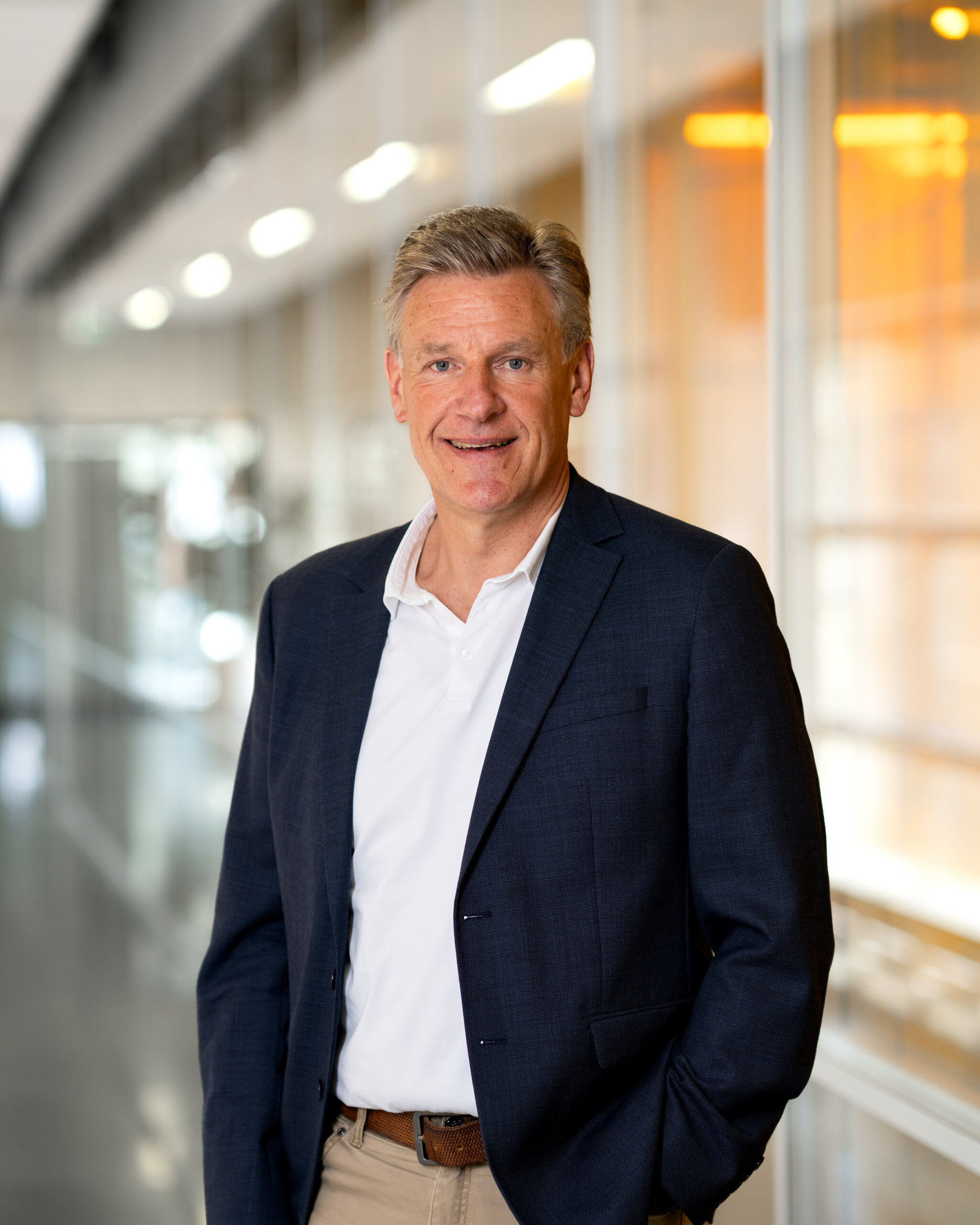
Starting from my time as a PhD student, I have always supervised students. And at Philips, I was part of a team of teachers, the CTT, who provided technical trainings to experts.
Johan Klootwijk
Focus on fabrication
It was his love for education that led to the part-time professorship of Johan Klootwijk. Since March 2025, he has been added to TU/e’s groups on Integrated Circuits and Photonic Integration for a combined one day a week.
Johan Klootwijk obtained his PhD in Electrical Engineering in 1997 from the University of Twente. ‘Immediately after, I joined Philips Research Laboratories, where I worked on several topics until it was closed in 2023. I then joined the Philips MEMS Foundry, which has as of 2025 turned into the independent company XIVER.’ The company focuses on three main technologies, Klootwijk explains: thin films and membranes, transducers, and photonics. ‘In XIVER we combine the strength of a pure-play foundry with more than 20 years of MEMS process development knowledge and experience in high-tech microsystems solutions.’
Even though he made a career in industry, he has always taken a keen interest in education. ‘Starting from my time as a PhD student, I have always supervised students. And at Philips, I was part of a team of teachers, the CTT, who provided technical trainings to experts.’ When Philips pulled the plug on these trainings, together with some colleagues Klootwijk started offering the courses externally.
Setting up TU/e course
In 2022, Klootwijk was approached by TU/e professor Peter Baltus, who was looking for someone who could help set up a course on silicon and III-V processing for Master students. ‘During the first few years, I had to take days off at Philips to spend time at TU/e during working hours,’ he recollects. ‘Together with Yuqing Jiao I developed the PIC Microfabrication course, which started out with 9 students in 2023, and welcomed 40 students last year. This year, we expect about 60 participants.’
The course uniquely addresses both IC and PIC device manufacturing. Students gain hands-on experience through a cleanroom process project, where they design their own process flow to manufacture their own chips. Klootwijk: ‘This course holds great potential, also to be further developed into a lifelong learning initiative. Industry is desperate to hire staff who know what cleanroom work entails.’
Speeding up transistors
Then Baltus asked Klootwijk if he’d ever considered a part-time professorship. ‘And here we are.’ His appointment at TU/e allows him to also conduct scientific research again. ‘I am looking into indium phosphide-based transistors. Over the past twenty years, their speed has not increased significantly. I want to investigate if, and if so, to what extent, we can make them faster with new fabrication techniques.’
With his professorship, Klootwijk hopes to help build bridges between XIVER and academia. ‘Our current collaborations with universities are mainly focused on ultrasound applications. For our photonic chip activities, we are still finding our way. Since we just started as a separate company, people now first need to get to know us.’
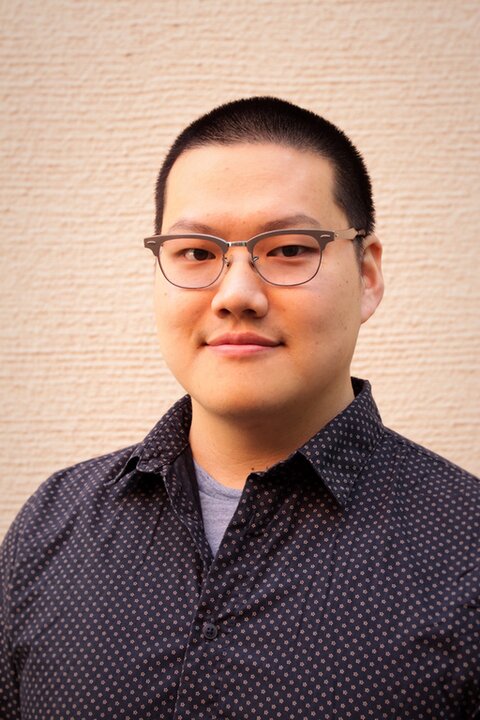
"In the future, we might be finding ourselves in the 2D Age. It would be great if I could discover new materials or properties to make that happen."
Martin Lee
Exploring new roads toward the 2D Age
Stacking two flat materials on top of each other and then changing the electronic properties of the resulting material by twisting, sliding, pulling, or compressing them: that is, in a nutshell, what is keeping assistant professor Martin Lee busy all day. Since February 2025, the Korean-Canadian researcher has been part of the Advanced Nanomaterials and Devices (AND) group.
It was a special issue of the journal Scientific American in April 2008 that first attracted physicist Martin Lee to two-dimensional materials. ‘I really liked the fact that with something simple like scotch tape, you could create cool new stuff with unmatched properties,’ he says, referring to the discovery of graphene.
After having obtained his master’s at McGill university in Canada and his PhD from TU Delft, Lee spent almost three years at Ludwig-Maximilians-Universität (LMU) München as a postdoc and subgroup leader. ‘Since I really liked the Dutch collaborative research atmosphere I had experienced during my PhD, I wanted to return to the Netherlands.’
Engineering crystals
As a principal investigator in the AND group, Lee focuses on how the transport properties of 2D materials change as they are distorted. ‘With 2D materials we have new possibilities to artificially engineer crystals by stacking layers to create a periodic structure. For example, by simply twisting two layers of graphene with respect to each other, you can change the material from a semi-metal to an insulator, a semiconductor or even a superconductor,’ says Lee, motivating his fascination for the subject.
‘There are over a thousand 2D materials known to date’, Lee explains. ‘For practical reasons, I now focus on the chemically stable ones, like the twisted graphene I mentioned before. Since I have a history in free-standing complex oxides, I would like to also get back into that class of materials sometime in the future.’
When it comes to building up his lab, an exciting development is going on, he says. ‘With my first master student and a PhD student who just started, we have built the third ever Quantum Twisting Microscope in the world which operates at room temperature. Our next target is to build one that operates at low temperatures to probe many-body physics in twisted 2D materials. We just installed our first cryostat in September.’ A QTM allows continuous in-situ twisting for the purpose of tuning the twist angle between two neighboring layers and probing the band structure of the underlying sample, Lee explains. ‘In our field, reproducibility is a great challenge. To twist graphene layers to the so-called magic angle of exactly 1,1 degrees is hard. With QTM we have a closed loop control over the twist angle, which provides us with direct feedback on how far to go.’
Lee feels he is working on the next big thing, he says. ‘We have had the Stone Age, the Bronze Age and the Iron Age. Now we are in the Silicon Age. In the future, we might be finding ourselves in the 2D Age. It would be great if I could discover new materials or properties to make that happen.’
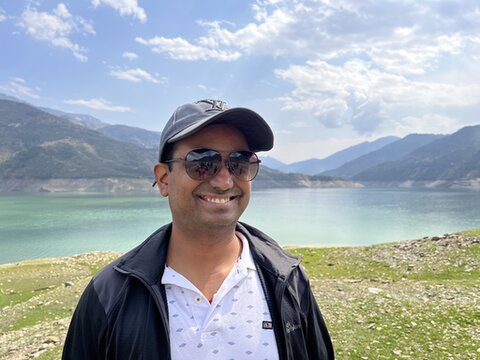
"I want to use science to develop technology that can help people. With that intrinsic motivation in mind, TU/e feels like a good place for me to contribute."
Sandeep Singh
Engineering helpful solutions
After travelling the globe, going from India to Germany, the United States and back, as of July 2025, Sandeep Singh has landed in Eindhoven to join the Electro-Optical Communication group as an assistant professor.
‘From early childhood on, I have been fascinated with electricity,’ Singh tells the tale of how he ended up in electrical engineering. ‘The fact that by flipping a simple switch you can instantly turn on the lights fascinated me immensely. During my bachelor’s in electronics and telecommunications I got intrigued by electronic systems, networks, chips and computers. Since I regarded photonics to be a promising upcoming field, I decided to switch to optics for my master’s.’
During an internship at Technical University of Berlin, the Indian researcher discovered that he really enjoyed the European research atmosphere. ‘So, when during a conference in Barcelona Admela Jukan, from the Technical University of Braunschweig, told me she had an opening for a PhD position, I decided to apply.’ After a short period of working at a German aerospace research center on topics that were too far away from optical networking, Singh’s pursue of an academic career brought him to the University of California Davis and back again to India, where he was associated with the Indian Institute of Technology Roorkee.
Oriented towards applications
‘Because of the favorable working conditions in Europe, I wanted to return,’ he motivates his recent move to the Netherlands. ‘At TU/e, the photonics field is well-established, and growing. The fact that there are a lot of close collaborations with industry, working on high end research that is close to applications and products, really appealed to me. Frankly, I’d rather call myself an engineer than a scientist: I want to use science to develop technology that can help people. With that intrinsic motivation in mind, TU/e feels like a good place for me to contribute.’
In his research, Singh focusses on control and monitoring in optical networks, including quantum networks. ‘One of the questions I address in my research is how to route data in classical and quantum optical networks, and establish long-distance quantum entanglement.’ To this end, Singh develops theoretical solutions which he then simulates to challenge their underlying assumptions. Finally, he puts his ideas to the test in an experimental set-up containing four to five network nodes, where he measures properties like throughput, latency and losses.
At the moment, the assistant professor is busy acquiring funds and seeking collaborations to build the required experimental set-up. ‘Ultimately, I want to develop solutions for quantum optical routers working towards a European quantum internet,’ is how the electrical engineer summarizes his ambitions.