Upscaling the Dutch integrated photonics industry
Recently, PhotonDelta finalized the mid-term review of its major National Growth Fund program, comprising investments totaling 1.1 billion euros for six years. CTO Peter van Arkel reflects on what has been achieved so far, and on the plans for the second phase of the program.

6
Developing the Dutch integrated photonics industry
Recently, PhotonDelta finalized the mid-term review of its major National Growth Fund program, comprising investments totaling 1.1 billion euros for six years. CTO Peter van Arkel reflects on what has been achieved so far, and on the plans for the second phase of the program.
7
Developing the ecosystem

Peter van Arkel
PhotonDelta CTO
In 2022, PhotonDelta was allocated 471 million euros in government funding within the National Growth Fund scheme. The final investment plan includes over 600 million euros in additional co-funding. The awarded public funds are divided into two phases, ranging from 2023 to 2025 and from 2026 to 2028.
‘Our main goals can be divided in three action lines,’ Peter van Arkel introduces the program. ‘Developing an integrated
photonics ecosystem, developing applications, and industrialization and scaling. Or, in other words: we establish collaborations, create new markets and focus on manufacturability.’
Multiple lines
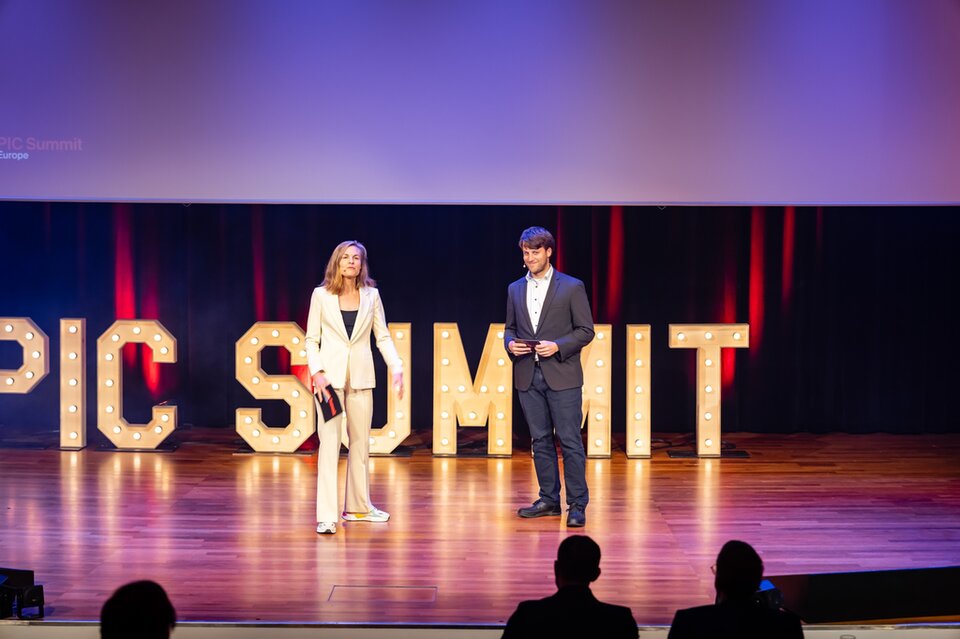
The Growth Fund enables PhotonDelta to subsidize relevant R&D efforts within companies, Research & Technology Organizations (RTO’s) and universities, to fund new startups, and to execute a talent program and a marketing and business development program. Van Arkel: ‘Our business developers are active in Europe, Asia and the US to identify collaboration opportunities with global partners in the integrated photonics space. We also organize our own events such as the annual PIC Summit Europe to generate exposure for the Dutch integrated photonics industry.’
When it comes to talent, PhotonDelta aims to both attract Dutch students to the field, and draw talent from abroad to the Netherlands. ‘And we help align education to the needs of industry,’ Van Arkel emphasizes. ‘For example, we have provided specialized lab tools to Dutch Universities of Applied Sciences, and, together with the three technical universities, launched the MasterPlus Optics and Photonics program.’ Another initiative in this regard is the launch of www.photonjobs.eu, a dedicated talent platform offering information about the industry and hosting all current job vacancies.
‘When it comes to startup funding, we supply funding up to two million euros in non dilutive loans,’ the CTO explains. The underlying idea is that public money attracts private money from venture capitalists, pension funds and strategic investors.
Funding the foundations
Finally, to secure the future of the PhotonDelta ecosystem, the program provides funding for groundbreaking innovation projects. ‘We detect international trends that we translate into technology roadmaps which we use to steer our programs. Besides our own development program aimed at maturing the technology, we also invest in fundamental research through a partnership with NWO. In 2025, we funded an integrated photonics oriented research program, and we expect these projects to start hiring researchers in the course of 2026.’
Building on achievements
The conclusion of the mid term review was that the PhotonDelta Growth Fund program has been very successful in achieving its goals, Van Arkel says. ‘Our companies have invested heavily in developing technologies, the factories for scaling manufacturing are being built, and we’ve been able to generate startups and attract companies to develop solutions with our technologies. Globally there is a lot of interest in working with our vibrant ecosystem. All in all, we have created fertile ground for a true integrated photonics industry to grow.
Now, the time has come to build further on these successes and solve large challenges of customers with integrated photonics solutions, he states. ‘Toward phase two of the program, 11 specific missions have been formulated (see box) where we are convinced that we can make a difference with integrated photonics,’ Van Arkel further explains the future plans.
- Data communication
- Quantum computing
- Quantum key distribution
- Optical switches
- Microwave photonics for Imaging and communication
- Augmented reality
- Optical coherence tomography
- LiDAR
- Structural health monitoring
- Spectroscopic sensing
- BioChips
11 missions for integrated photonics
dw
A mission is an ambitious goal that requires a multidisciplinary collaboration between multiple partners, solving some of societal challenges, closely linked to the megatrends, he explains. ‘We have formed 11 consortia composed of universities, research and technology organizations, application developers and foundries, to realize these missions with the aid of photonics.’
In the meantime, the PhotonDelta organization is looking even further ahead. ‘We have appointed a PhD researcher at TU/e who is looking into the role of PhotonDelta itself as an ecosystem orchestrator. PhotonDelta is a pioneer in the field and we want to get a grip on where and how we can increase our impact even further. At the moment we are the only organization in the world that combines talent development, funding, reporting and roadmapping for integrated photonics. This PhD researcher is going to investigate the possible roles ecosystem orchestrators can play, with PhotonDelta as a use case. We want to use the lessons from this research to shape the next phase for our mission to build a mature integrated photonics industry in Europe that is firmly rooted in the Netherlands.’
‘Toward phase two of the program, 11 specific missions have been formulated where we are convinced that we can make a difference with integrated photonics’